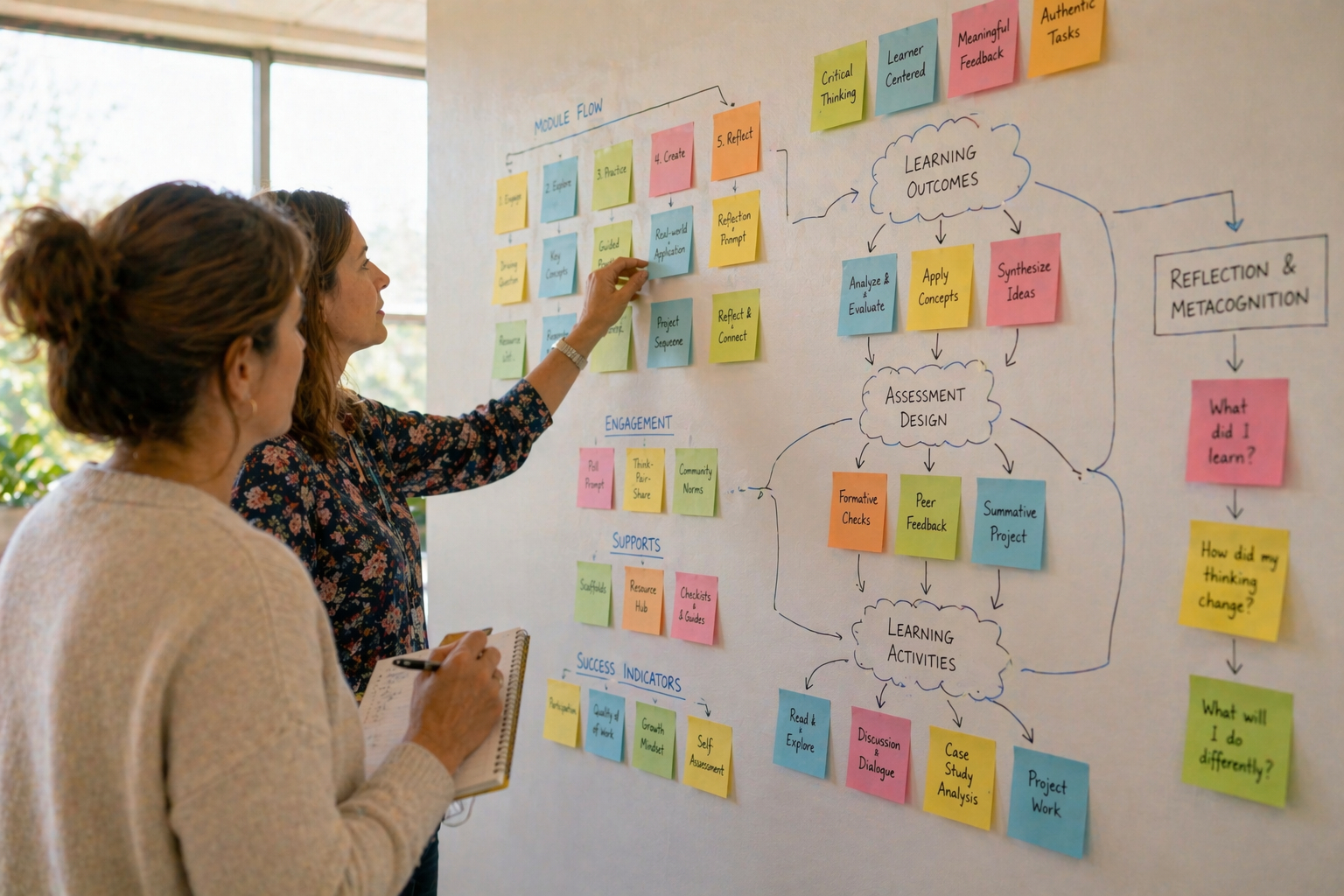
Online programs succeed when they move beyond surface memorization and cultivate durable understanding. Design choices that promote connection, application, and reflection help learners integrate new ideas into existing frameworks. This introduction outlines actionable approaches instructors and designers can use to deepen online learning experiences. These strategies favor meaningful practice, thoughtful assessment, and supports that encourage transfer to real contexts.
The goal is learning that lasts and adapts, not just short-term recall.
Designing for Depth
Design that encourages deep learning starts with clear, challenging tasks that require synthesis and reasoning rather than repetition.
Learners should work on problems that mirror real situations and invite multiple strategies or perspectives.
Sequence activities so each builds on prior understanding and increases in complexity to scaffold cognitive effort.
Use varied media and prompts to engage analytic, creative, and practical skills in parallel.
By prioritizing complex tasks and progressive challenge, courses signal that understanding matters more than speed.
This design creates opportunities for learners to revisit and refine their thinking over time.
Assessments That Measure Understanding
Authentic assessments reveal whether learners can apply concepts in new contexts and explain their reasoning. Include performance tasks, case analyses, and short projects that demand explanation and justification of decisions. Mix formative checks for misconceptions with summative tasks that integrate learning across modules.
Feedback should be specific, timely, and oriented toward next steps for improvement.
Well-designed assessments both diagnose learning gaps and celebrate demonstrated competence. They guide learners toward deeper engagement by making expectations transparent and attainable.
Supporting Reflection and Transfer
Reflection activities help learners make connections between experiences, concepts, and future application opportunities.
Prompts for metacognition, learning journals, or peer discussions encourage learners to articulate what they learned and how they learned it.
Design transfer tasks that explicitly ask learners to adapt ideas to new scenarios or to plan future use.
These practices reinforce neural pathways and highlight the practical value of course content.
Supporting reflection transforms isolated tasks into an integrated learning journey.
When learners see relevance and rehearse transfer, knowledge becomes more resilient and usable.
Conclusion
Deep learning in online programs requires intentional task design, meaningful assessment, and reflection. Together these elements promote durable understanding and real-world transfer. Implementing these strategies improves learner outcomes and fosters lasting competence.