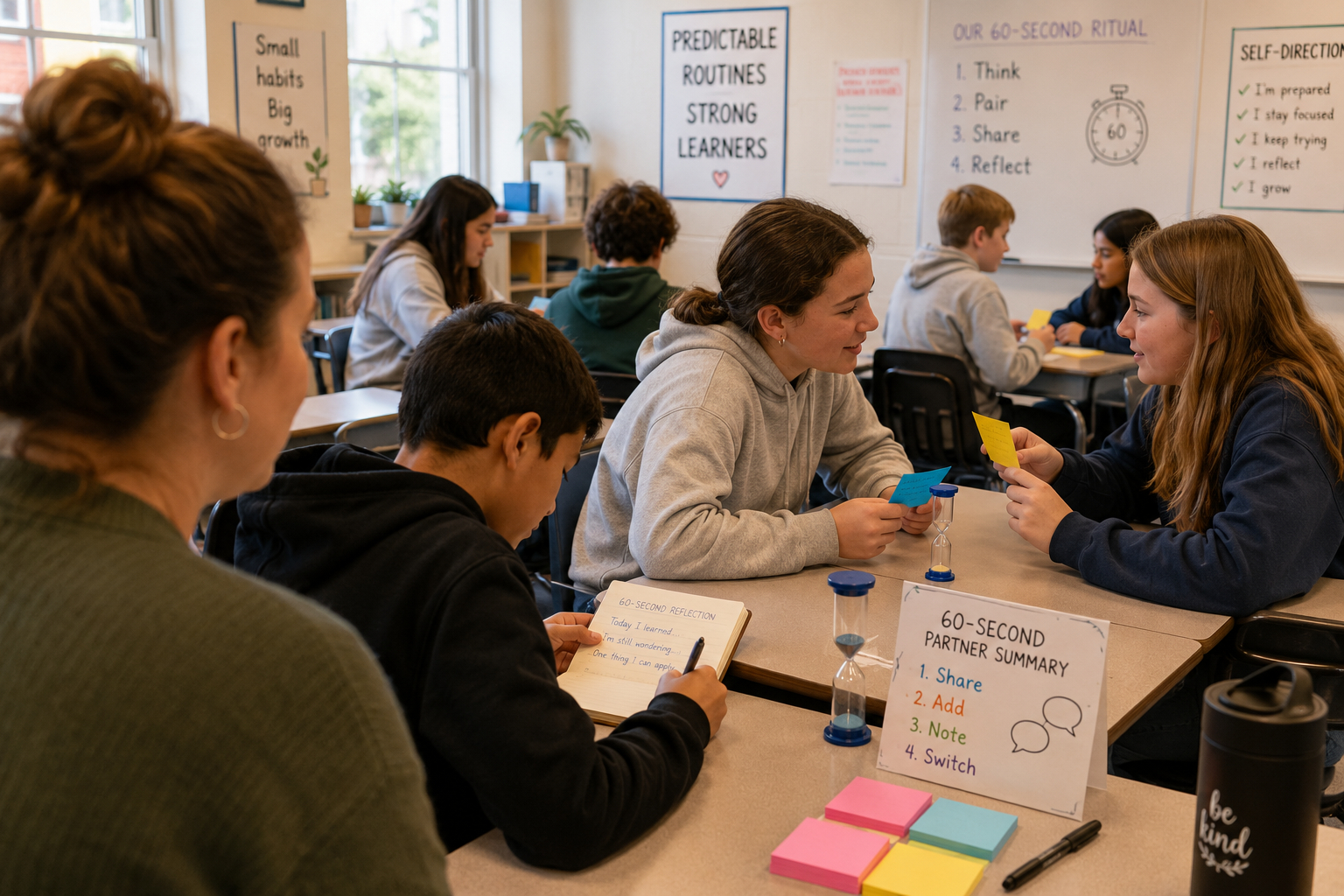
Compact classroom rituals give teachers a reliable way to build student independence without overhauling curriculum. When repeated with intent, brief routines help students internalize habits for planning, monitoring, and reflecting on learning. They work because they are predictable, time-efficient, and easy to transfer across lessons. This piece explains why short rituals matter and how to design, implement, and refine them for stronger student self-direction.
Why compact rituals work
Short, regular rituals reduce cognitive load by creating predictable frames for activity so students can focus on content rather than procedure. Habit formation research shows that small, frequent actions become automatic more quickly when they are context-specific and easy to complete. Classroom rituals also create common language and expectations, which speeds transitions and increases time on task. Finally, brief routines offer frequent opportunities for low-stakes practice of self-regulation skills like setting goals and checking understanding.
Because rituals are concise, they fit into busy schedules and can be deployed across subjects. Over time, students begin to carry these strategies into independent work.
Designing rituals to match learning goals
Begin by identifying the specific habit or skill the ritual should develop, such as goal-setting, retrieval practice, or error analysis. Keep the action narrow: a two-minute retrieval prompt or a one-minute goal check is easier to routinize than a broad multi-step task. Define clear success criteria so students know what completion looks like and how to self-evaluate. Include language prompts and visual supports for the first weeks to reduce ambiguity and speed adoption.
Alignment with lesson objectives ensures the ritual reinforces learning rather than becoming an add-on. Gradually remove supports as students show competence.
Practical five-minute ritual examples
Simple examples can be implemented immediately and adapted to grade level or content area. A quick entry task might ask students to retrieve a fact from the previous lesson; a two-minute partner summary builds synthesis skills; and an exit reflection invites students to note one success and one next step. Consistency in timing and wording makes these rituals predictable and efficient.
- Entry retrieval: 90 seconds to write three recall prompts.
- Check-in goals: 60 seconds to set a specific target for the lesson.
- Exit reflection: 2 minutes to record progress and next steps.
Rotate or combine these rituals to prevent monotony while keeping the overall structure familiar. Share rubrics or quick checklists to speed student self-assessment.
Monitoring and iterating rituals
Collect brief evidence of impact through student reflections, quick checks of student work, or sampling participation rates. Solicit student feedback on clarity and usefulness to identify friction points and ensure rituals feel meaningful. Make small adjustments to wording, timing, or supports rather than discarding practices at the first sign of inconsistency. Track changes over a few cycles to see whether rituals are accelerating independence or need further scaffolding.
Iteration keeps rituals responsive and sustainable. Over time, the goal is to fade teacher prompts so students sustain the routine themselves.
Conclusion
Start small and be deliberate about purpose and language. Use brief, consistent rituals that align to learning goals. Refine with student input and simple evidence to grow lasting independence.