Classroom routines are more than time-savers; they are scaffolds for stronger executive skills. When teachers design concise, repeatable moves, students practice planning, monitoring, and adjusting their approach to learning. Small rituals anchored to explicit goals help learners internalize processes that previously relied on adult direction. This article outlines practical moves and implementation tips that support sustainable student growth.
Why minimal rituals matter
Minimal, predictable routines reduce cognitive load and create space for higher-order thinking. By automating transitions, expectations, and quick checks, students can allocate attention to strategy, reflection, and problem solving. These rituals also make behavior and academic expectations transparent, which supports equitable access to executive practice. Over time, consistent practices turn external prompts into internal habits.
Teachers gain clearer classroom flow and can use brief formative signals instead of repeated instructions. That shift frees time for targeted coaching while students practice autonomy. The payoff is measurable in smoother lessons and more confident independent work.
Practical classroom moves to teach executive habits
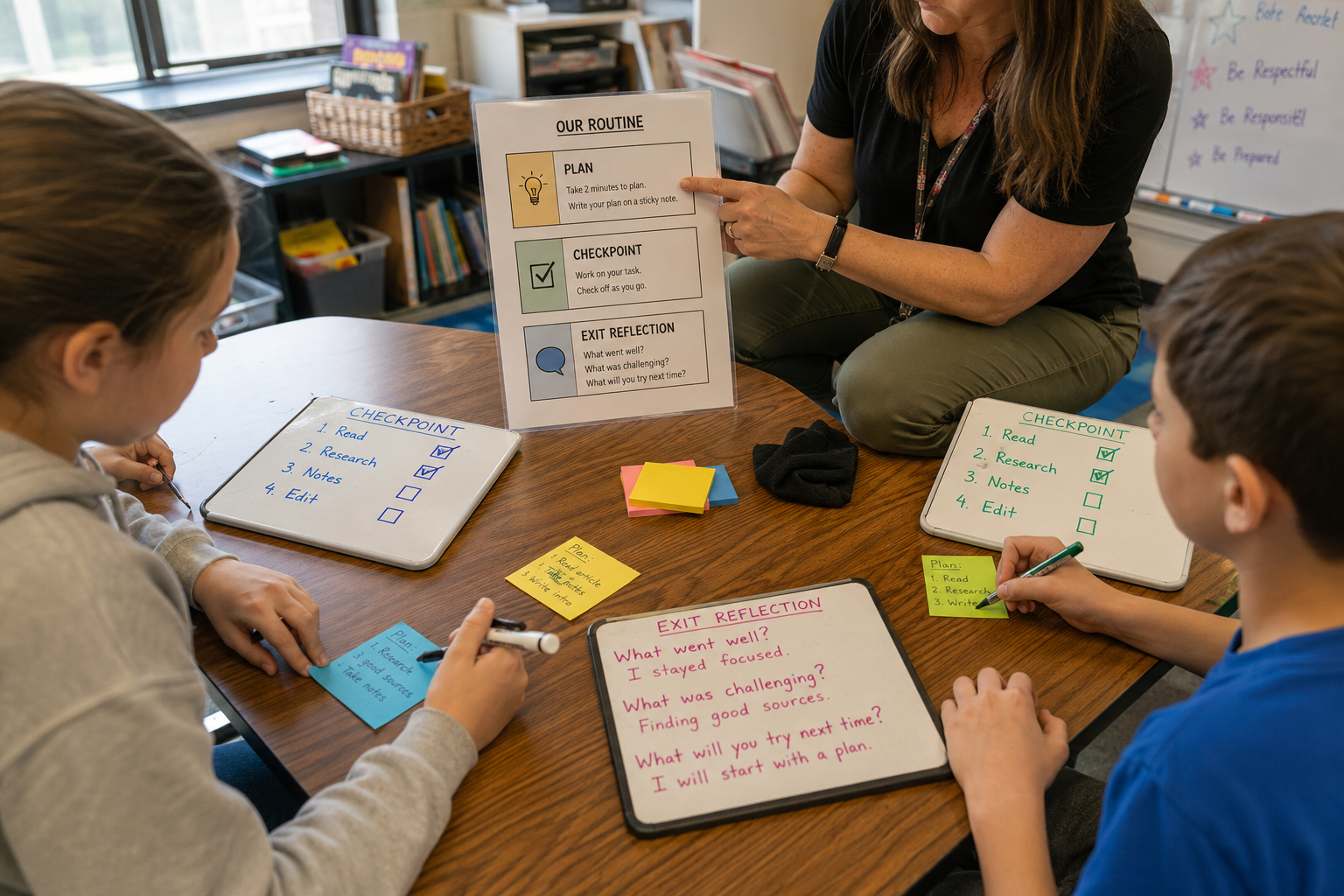
Start with three compact moves that are easy to teach and sustain: a two-minute planning prompt before tasks, a mid-task checkpoint for self-monitoring, and a one-minute exit reflection. Each move emphasizes a specific executive function: planning, monitoring, or reflection, and can be adapted to any subject or grade. Use simple language and a visible routine cue so students know when to engage. Consistency matters more than complexity—short, repeated practice embeds the habits.
- Two-minute plan: Students list steps and a time estimate.
- Checkpoint prompt: Students mark progress and adjust next steps.
- Exit reflection: Students note one success and one next step.
Introduce each move slowly, model it explicitly, and celebrate visible use. Rotate scaffolds out as students demonstrate independence.
Monitoring, adjusting, and scaling routines
Track fidelity with quick teacher notes or short student self-records to know which moves stick and which need tweaking. Collecting a few anonymized examples each week helps identify common breakdowns and informs small adjustments. When routines succeed with most students, scale by increasing student responsibility or by integrating the moves into project rubrics. Keep expectations clear and revisit routines after breaks to maintain momentum.
Use collaborative reflection with students to co-design improvements and to reinforce ownership. Small adjustments sustain relevance and keep routines from becoming rote.
Conclusion
Compact, consistent classroom moves develop the underlying skills students need to direct their own learning. By teaching short planning, monitoring, and reflection rituals, educators create conditions for durable executive habits. With careful monitoring and incremental adjustments, these routines can scale across lessons and learners.