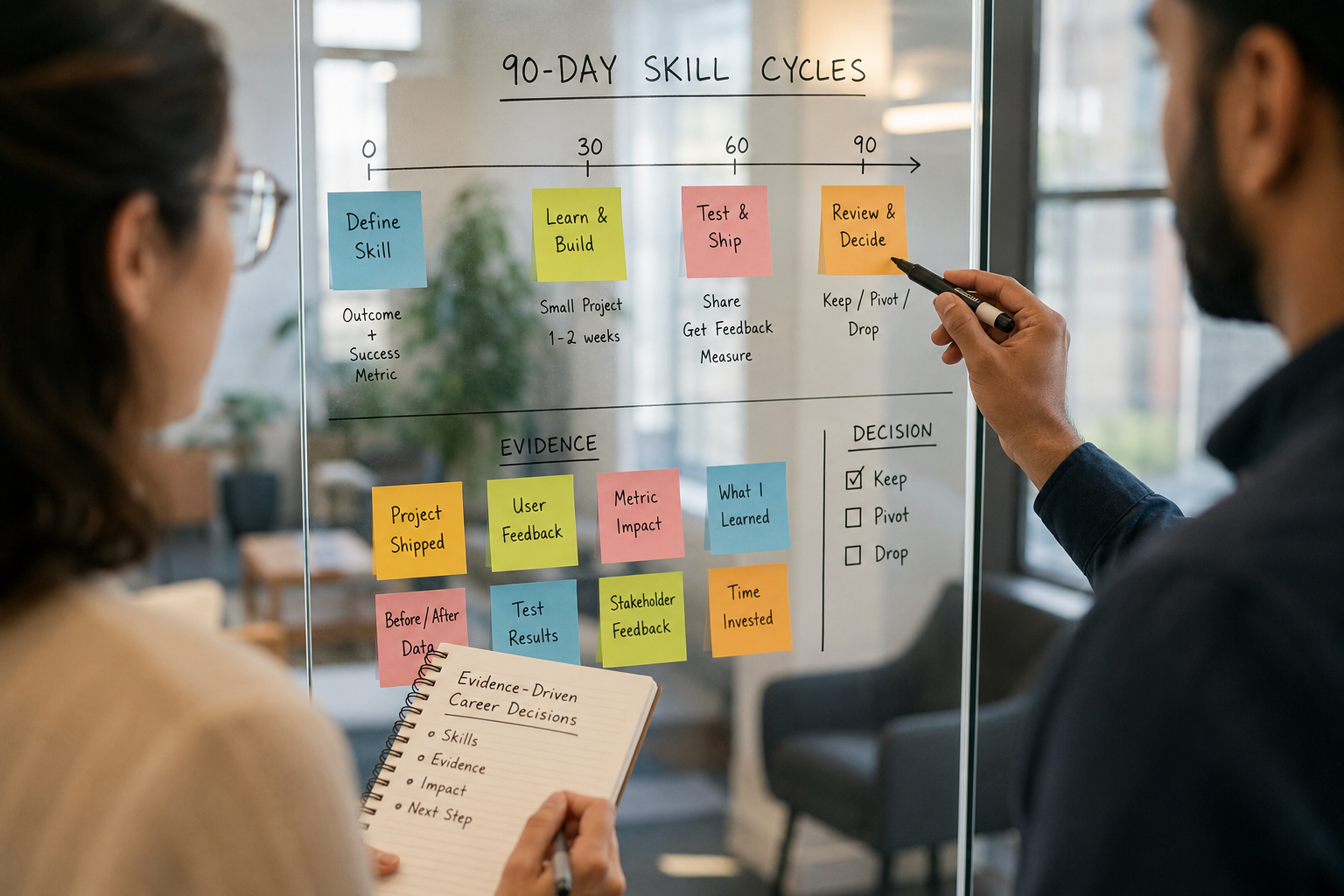
Career progress often stalls when learning becomes a vague, long-term promise rather than a structured test. Short skill cycles turn learning into small, measurable experiments that reveal whether a direction is worth pursuing. This approach reduces wasted effort, clarifies priorities, and creates visible evidence you can show to others. The method works for people in transition, those aiming for promotion, and anyone seeking a clearer professional path.
Why short skill cycles work
Short cycles create rapid feedback loops that show which efforts produce meaningful results. Instead of committing months to a broad topic, you pick a target, define success criteria, and run a time-boxed effort to collect evidence. That evidence could be a small project, a measurable improvement in a metric, or peer feedback tied to a specific task. Rapid learning reduces risk and helps you pivot sooner when a direction doesn’t pay off.
Working in cycles also builds momentum: repeated wins compound confidence and make it easier to justify further investment. Because each cycle is intentional and constrained, you preserve time for other priorities while still moving forward.
Choose the right skills for a cycle
Select skills that map directly to the roles or outcomes you want next. Prioritize high-impact abilities that are visible in shared work—presentation design, data storytelling, automated testing, or stakeholder negotiation are examples with clear evidence. Define a narrow scope for each cycle so success is testable within weeks rather than months. Avoid aiming for vague improvements; pick a measurable change tied to a real deliverable.
By aligning skills to desired outcomes, you ensure each cycle produces transferable proof that others can evaluate. This makes it easier to convert short wins into career conversations or portfolio entries.
Design a compact proof for each cycle
Each cycle should end with a concrete artifact or metric that demonstrates progress. That could be a mini-project, a before-and-after performance metric, or documented peer reviews related to the new skill. Keep the deliverable simple but relevant so it’s easy to share and discuss. A thoughtful debrief that connects the work to business impact increases the proof’s credibility.
Packaging evidence consistently—title, objective, method, result—creates a library of proofs you can reference when updating résumés or preparing for interviews. Over time, those proofs form a coherent narrative of growth.
Iterate, scale, and integrate wins
After each cycle, reflect on what you learned and decide whether to deepen, broaden, or pivot. If a skill moves the needle, plan a follow-up cycle that increases complexity or stakes. If it doesn’t, treat the outcome as informative and choose a new hypothesis to test. Regular retrospectives keep progress intentional and avoid accumulating unfocused training tasks.
Integrating successful cycles into daily work amplifies impact: weave proven techniques into routine projects and cite cycle outcomes in performance conversations. This turns episodic learning into lasting professional advantage.
Conclusion
Short skill cycles make career development accountable and evidence-driven. They reduce risk by delivering quick feedback and build a portable record of achievement. Adopt cycles to test direction, prove capability, and accelerate meaningful career moves.