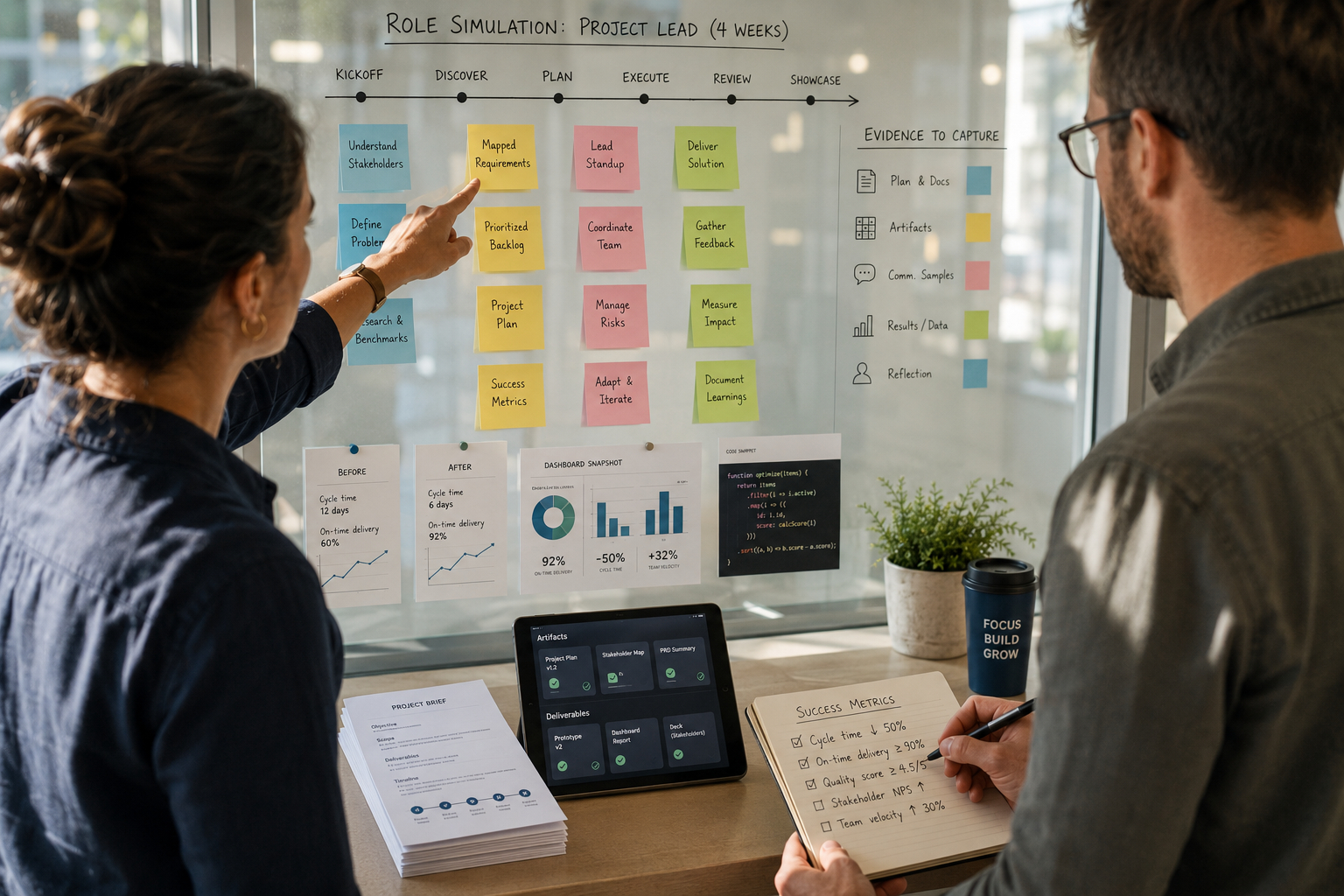
Role simulations are short, focused exercises that let you trial a higher-responsibility job or a new function without committing to a full transition. They replicate the critical decisions, tasks, and stakeholder interactions of a target role on a compact timeline.
When designed intentionally, simulations produce observable evidence of capability you can show in reviews, interviews, or promotion conversations. This article explains how to design, run, and document micro role simulations to demonstrate readiness and reduce risk.
Why role simulations work
Simulations compress learning into a realistic context where outcomes matter and feedback is immediate. They reveal gaps you might not notice through isolated training or coursework, because they force you to integrate skills under pressure. Employers and managers prefer concrete results and examples, and a successful simulation generates both performance signals and artifacts. Done well, simulations reduce uncertainty for you and the organization when considering a role change.
Simulations also let you trial-fit a role without a permanent move, lowering career risk. They encourage deliberate practice in the specific behaviours that matter most.
Designing a micro-simulation
Start by mapping the target role’s top three responsibilities and the decisions that determine success. Choose a real problem or project slice you can complete in two to six weeks, and define measurable outcomes that reflect impact, not just effort. Identify stakeholders who can act as reviewers or collaborators and agree on boundaries so the experiment stays focused and respectful of current priorities. Build evaluation criteria that combine quantitative metrics and qualitative feedback.
- Pick one priority deliverable that mirrors a role competency.
- Set a short timeline and define success metrics.
- Secure a reviewer or mentor to provide candid feedback.
Keep the simulation small enough to finish cleanly but substantial enough to produce meaningful evidence.
Run, measure, and iterate
Execute the simulation with intentional checkpoints and record decisions and trade-offs as they happen. Use simple metrics to track progress and gather stakeholder impressions at prearranged intervals. Treat feedback as data and iterate quickly: adjust scope, methods, or communication if results show a misalignment with role expectations. A disciplined run demonstrates not only technical ability but also learning agility and stakeholder management.
Reflect after each cycle and decide whether to broaden the simulation, repeat it, or move toward a formal role change based on evidence gathered.
Document outcomes as career evidence
Capture artifacts that tell the story of what you did and why it mattered: short case summaries, before-and-after metrics, stakeholder testimonials, and sample deliverables. Organize these into a concise portfolio entry that highlights the problem, your approach, measurable outcomes, and lessons learned. When discussing career moves, present the simulation as a controlled experiment that shows readiness and reduces hiring risk. This approach makes your case concrete and repeatable.
Use these artifacts in performance reviews, applications, or promotion talks to move conversations from hypothetical potential to demonstrated impact.
Conclusion
Run focused, time-boxed simulations of the role you want to test and measure outcomes against clear criteria. Document artifacts and feedback so you can show tangible evidence of readiness. This method reduces risk while accelerating career decisions with real proof.