Brief, focused peer challenges are a low-friction way to build student initiative and collaboration. When tasks are small and clearly bounded, more students participate and practice decision-making. These challenges can be embedded into transitions, openings, or as quick checks for understanding. Over time they create a culture where learners expect to try, reflect, and adjust with peer feedback.
Why brief peer challenges work
Small peer challenges reduce the cognitive load students face when approaching unfamiliar tasks and make risk-taking feel safer. They provide frequent opportunities for formative practice, so learners refine strategies in short cycles rather than waiting for major assessments. Peer interaction accelerates metacognitive growth because students must explain their reasoning and confront alternate approaches. The social element also increases engagement, as many learners value brief relational exchanges during learning.
Because these tasks are concise, teachers can circulate and notice common misconceptions quickly. They also afford flexibility: teachers can layer supports, vary grouping, or adjust complexity without redesigning an entire lesson.
Design principles for effective tasks
Well-designed brief challenges have a clear objective, an immediate product, and a quick reflection component so students can anchor learning. Keep instructions explicit and time-bound to ensure momentum, and design tasks that require justification rather than just answers to promote deeper thinking. Aim for high-entry, low-ceiling prompts so all students can participate while still allowing extension for advanced learners. Finally, include a simple rubric or success criteria so peers know what to look for during review.
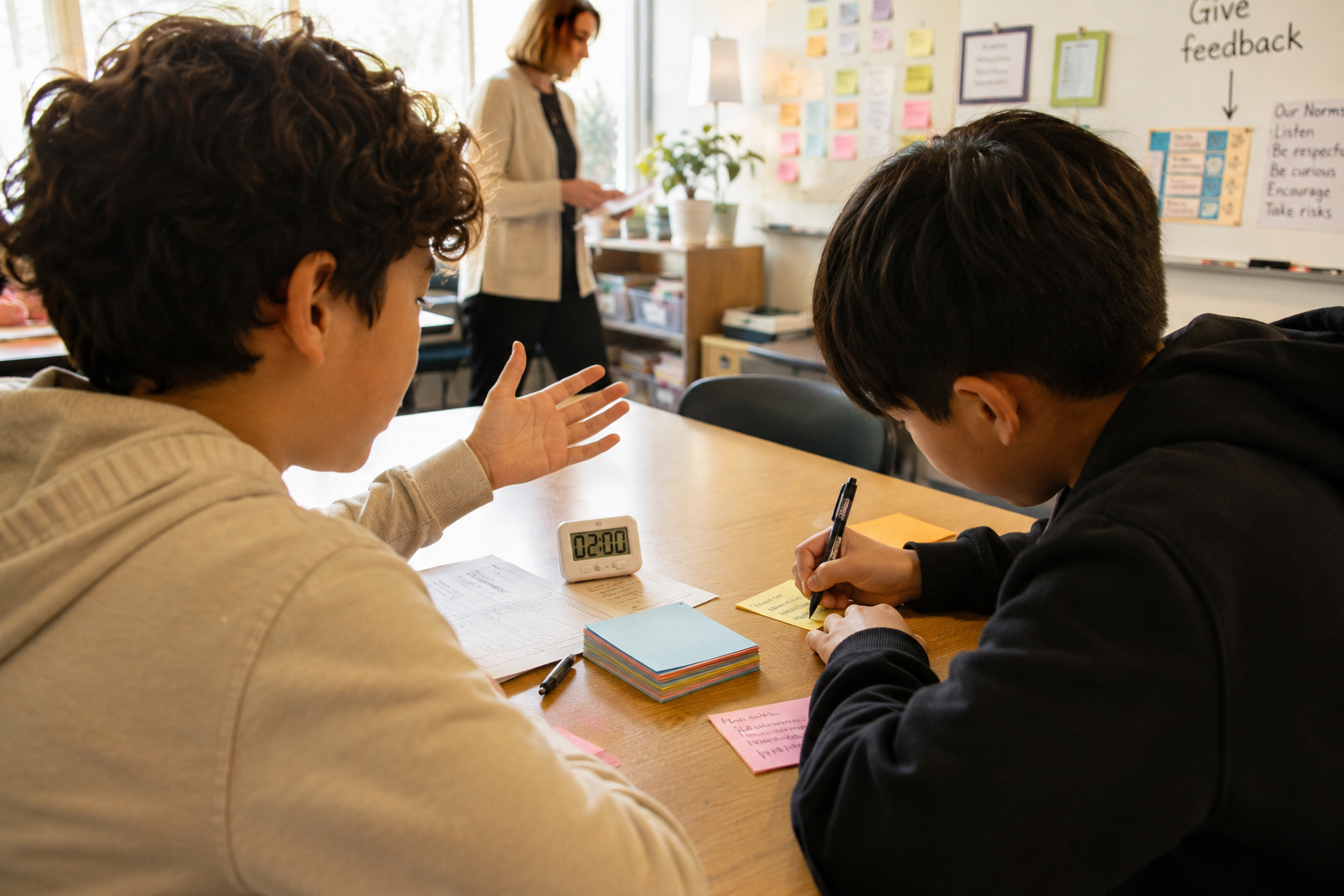
- Two-minute explanation: one student summarizes, the other asks one clarifying question.
- Three-step proof: claim, evidence, and a sentence connecting them.
- Quick revision: swap drafts and suggest one concrete improvement.
These small formats keep momentum and model constructive feedback, making peer work reliable and productive.
Classroom routines to support them
Establish predictable logistics for pairing, timing, and sharing so transitions are smooth and instructional time stays focused. Teach and rehearse feedback language and norms explicitly so students give useful, respectful comments. Use a visible timer and simple prompts to keep exchanges brisk, and rotate partners to broaden perspectives and social skills. Collect quick exit notes periodically to track progress and guide subsequent instruction.
Over weeks, these routines embed a habit of short, iterative collaboration that scales to larger projects. The predictability helps students take initiative because expectations and structures are familiar.
Conclusion
Brief peer challenges offer a practical pathway to increase student initiative while keeping teacher workload manageable. When designed with clear goals, simple criteria, and reliable routines, they produce frequent practice and feedback. Implemented consistently, these small tasks build a classroom culture of thoughtful, collaborative learning.