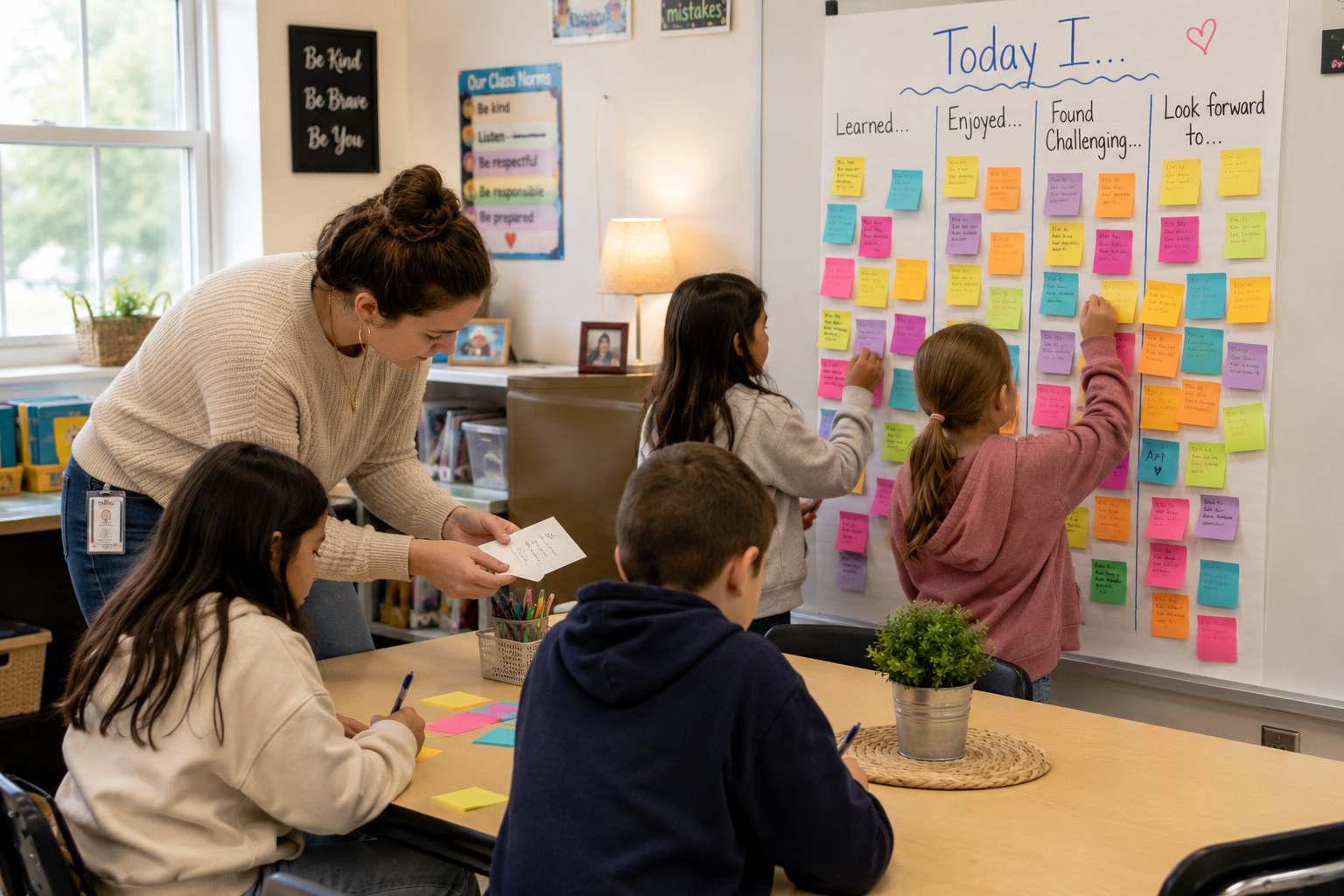
Lightweight reflection routines give students a quick way to consolidate learning and develop metacognitive awareness without taking class time away from instruction. Short, consistent prompts encourage habit formation and make thinking visible to teachers. This article outlines why brief reflections work and offers practical templates teachers can adopt.
Why brief reflection works
Brief reflections lower the activation energy for metacognition by making the task short and predictable. Students are more likely to complete a one- to three-minute prompt than a longer written assignment, and repeated practice builds fluency in monitoring understanding. These routines also generate frequent diagnostic information that teachers can use to adjust instruction the following day. Over time, small reflections compound into stronger self-regulation and clearer goal setting.
- Immediate low-friction insight into student thinking.
- Regular practice that strengthens monitoring skills.
- Actionable patterns for instructional adjustment.
When designed intentionally, these benefits appear quickly and require minimal materials. The key is consistency and clarity about the expected output.
Simple templates teachers can use
Start with three straightforward templates that fit most lessons and grade levels. An exit prompt asks students to name one idea they learned and one question they still have; a progress snapshot asks learners to rate their confidence and justify the score briefly; a transfer prompt asks students to describe where they might use this learning next. Each template can be completed orally, on a sticky note, or via a quick digital form. Flexibility in medium keeps the routine sustainable across contexts.
- Exit prompt: one learned idea + one question.
- Confidence snapshot: rate and justify.
- Transfer prompt: where will this apply?
Rotate these templates across the week to maintain novelty while keeping the structure predictable. Clear rubrics or sentence stems help students produce useful responses quickly.
Implementing routines with fidelity
Introduce routines explicitly and model several high-quality examples before asking students to do them independently. Build the routine into a predictable moment of the lesson — for example, the last three minutes — and reinforce participation through brief feedback or class-level summaries. Use small data from reflections to adjust upcoming lessons rather than to grade individual students. Over time, gradually shift ownership to learners so they set the prompts and monitor progress.
- Model examples and provide sentence stems.
- Collect aggregate feedback, not punitive checks.
- Shift ownership to students progressively.
Consistent practice and low-stakes accountability create durable habits. Keep evaluation formative and focused on growth.
Conclusion
Short, repeatable reflection routines make metacognition manageable for both students and teachers. With clear templates and predictable timing, classrooms can embed reflection without losing instructional time. Small, sustained efforts produce measurable gains in student self-awareness and learning transfer.