Helping students move a skill from one lesson into new situations is one of the most powerful outcomes teachers can aim for. When learners notice patterns and apply methods flexibly, classroom time yields deeper understanding and long-term retention. Transfer does not happen by accident; it requires deliberate teacher moves that highlight connections across activities and contexts. This piece outlines practical classroom strategies to make transfer visible and teachable for learners at all levels.
Why transfer matters
Transfer turns isolated practice into adaptive competence, enabling students to solve new problems with familiar tools. When instruction emphasizes transfer, students develop mental models rather than memorized procedures, which supports creativity and resilience. This shifts assessment goals away from rote recall and toward evidence of flexible application. Emphasizing transfer also prepares learners to synthesize knowledge across subjects and to approach unfamiliar tasks with confidence.
Helping students see usefulness and similarity between tasks strengthens motivation to generalize. When educators name similarities explicitly, learners begin to recognize cues that suggest which strategies will work. That recognition is the first step toward independent transfer.
Strategies to build transfer in lessons
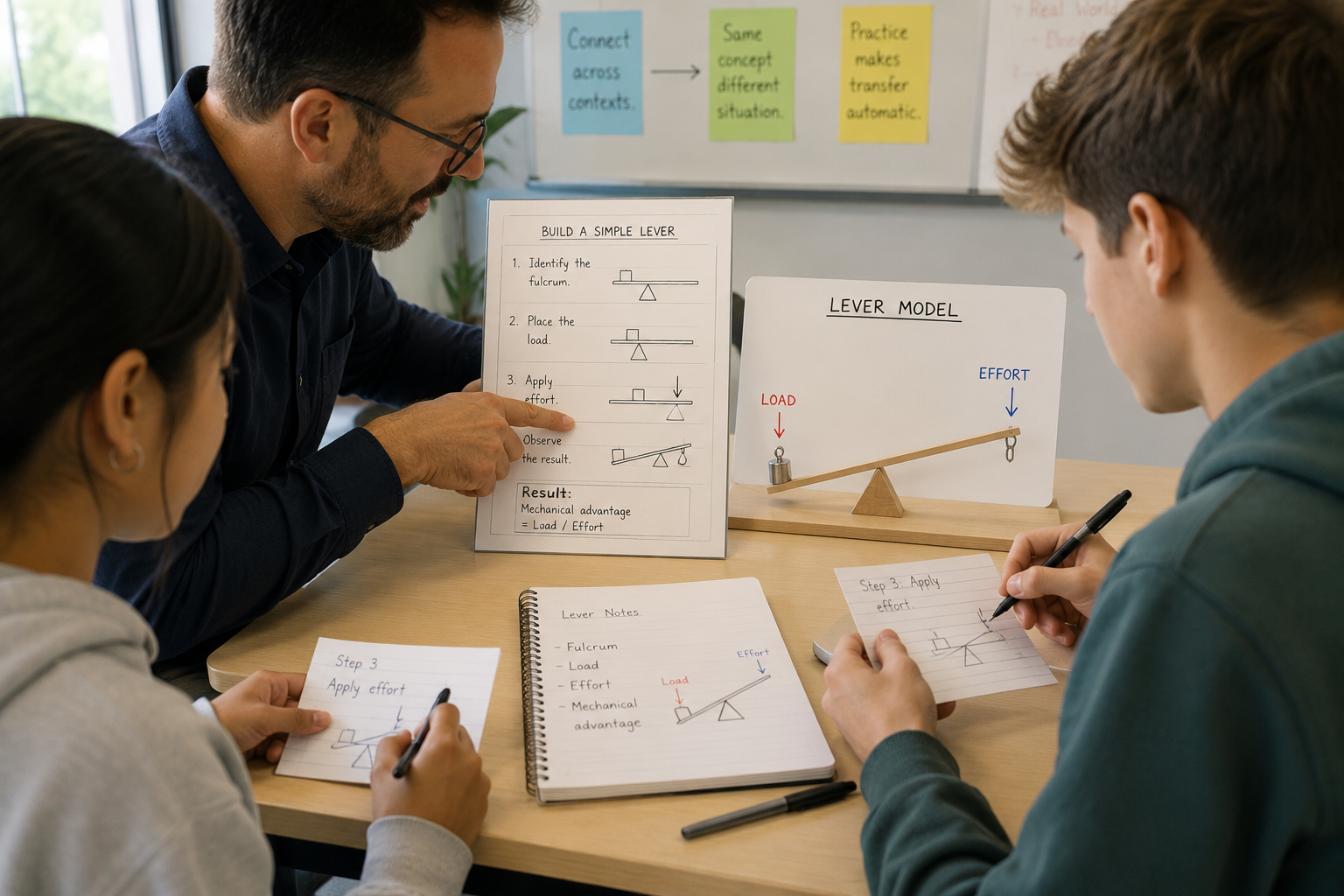
Start with explicit comparison tasks that ask students to identify what changed and what stayed the same across problems or texts. Use worked examples followed by faded support so students practice adapting a modeled approach. Incorporate prompts that require justification: ask learners to explain why a method fits a new context. Teach metacognitive language—phrases like “This is similar because…”—so students can label connections on their own.
- Model analogical thinking with short think-alouds.
- Create transfer checklists students use when approaching new tasks.
- Use exit prompts that ask: “Where else could you use this?”
These practical steps help students build a habit of seeking transferable features rather than treating every task as isolated. Over time the goal is that prompts become internal questions students ask independently.
Design tasks that mimic future contexts
Designing assignments that echo real-world constraints makes transfer more likely because students practice under conditions similar to future use. Project-based tasks, authentic problems, and interleaved practice invite learners to select and adapt strategies. Vary contexts deliberately so students encounter a concept across language, problem types, and media. That variability prevents students from tying a skill too tightly to one routine or surface feature.
When tasks are intentionally varied, assessment can focus on process and decision-making rather than only correct answers. Provide feedback that highlights transferable elements of student work to reinforce generalization.
Assess and reflect for durable transfer
Assessment for transfer asks students to explain choices, compare approaches, and apply skills in novel settings. Use brief reflective activities such as learning logs or peer discussions to capture where transfer succeeded and where it stalled. Rubrics that include a transfer dimension encourage learners to prioritize flexible thinking during practice. Frequent, low-stakes opportunities to try skills in new ways reduce anxiety and improve adaptability.
Reflection closes the loop: when students articulate how they adapted a strategy, their understanding becomes more portable. Teachers can collect these reflections to guide future instruction and to scaffold students who need more explicit connection-making.
Conclusion
Teaching for transfer requires explicit comparison, varied practice, and reflective assessment so students learn to recognize when and how to apply skills. Small, consistent classroom moves—modeling, prompts, and authentic tasks—help make transfer habitual rather than accidental. With deliberate design, teachers can cultivate learners who apply knowledge flexibly across lessons and contexts.