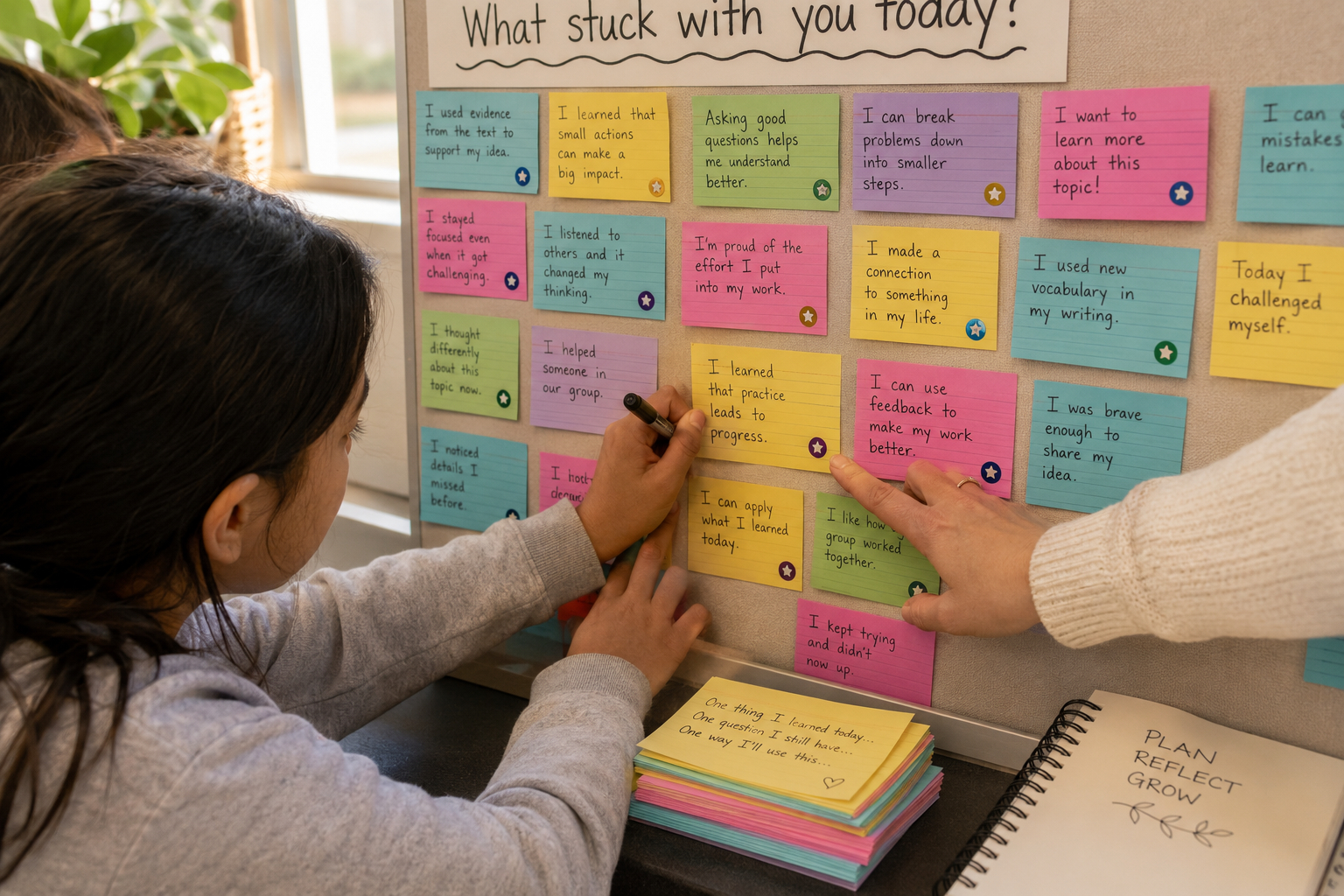
Short, focused reflection prompts give students a clear path to notice and shape their own learning. They take minimal class time yet create frequent moments of metacognition that accumulate over weeks. When students answer the same kinds of prompts consistently, they learn to recognize useful strategies and gaps. This steady, low-friction practice supports independence without adding planning burden for teachers.
Why brief reflections work
Brief reflections reduce cognitive overhead and make metacognition accessible to learners at every level. By limiting scope to a single question or idea, students can respond quickly and authentically without performance pressure. The repetition of a few targeted prompts helps build patterns of self-observation and corrective action. Over time those patterns become habits that transfer across subjects and tasks.
Teachers benefit because short prompts are easy to integrate into routines like exit tickets or warm-ups. They also produce small, usable data points that inform instruction and student conferences. Consistency matters more than complexity.
Designing effective prompts
Effective prompts are concrete, focused, and actionable so students know what to attend to and how to respond. Aim for questions that target strategy, confidence, or next steps rather than broad judgments of ability. Keep language age-appropriate and consistent across weeks so learners can compare their responses. Rotating a small set of prompts helps avoid redundancy while maintaining continuity.
- What helped you understand this idea today?
- What would you try differently next time?
- Which part of the work feels most confusing right now?
Sample prompts like these can be introduced explicitly and practiced until students use them independently. Offering sentence starters reduces friction for writers and creates better-quality responses to analyze.
Classroom routines that scale
Integrate prompts into predictable moments: a two-minute warm-up, a mid-lesson checkpoint, or a five-minute exit reflection. Use low-tech tools such as index cards, shared notebooks, or digital forms to collect responses without disrupting flow. Provide quick feedback loops by summarizing common themes for the class or by scheduling short one-on-one check-ins. Over time, expect reflections to become shorter and more targeted as students internalize the habit.
Scaling also means involving students in interpreting the responses and setting goals. Peer sharing, brief conferences, or thematic charts help learners see progress and adjust strategies. Small structures fostered consistently lead to durable independence.
Conclusion
Brief, consistent prompts create a lightweight metacognitive architecture that students can carry forward. They make self-observation habitual and actionable while keeping classroom implementation simple. With regular use, these prompts help learners develop reliable independence and more strategic study habits.