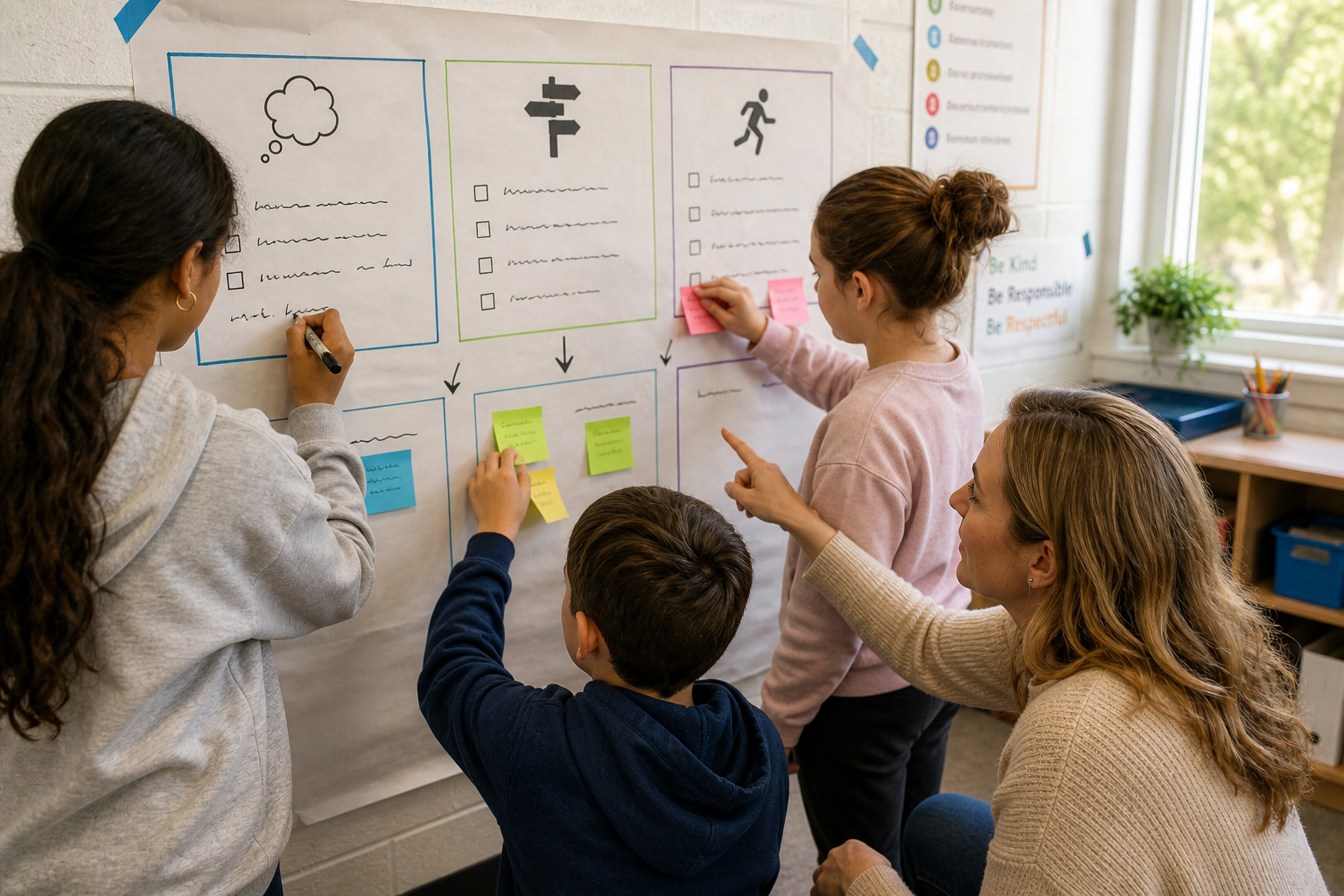
Learning maps are visual, portable plans that help students track goals, strategies, and progress in a clear way. When learners design their own maps they draw on metacognition, choice, and reflection to make study time more intentional. This piece outlines practical steps teachers can use to introduce map-building, keep the process simple, and embed routines that make maps meaningful. The goal is to give students a repeatable system that supports independent planning and measurable growth.
Introducing student-created maps need not be time-consuming; with a few structured prompts and brief check-ins, maps become a living tool rather than a classroom artifact.
Why student-led maps work
Maps shift ownership: students decide which standards or skills to prioritize and choose strategies that match how they learn best. By naming specific targets and checkpoints, learners develop clearer criteria for success and can self-assess more accurately. Maps also externalize planning, reducing cognitive load so students can focus on execution instead of trying to hold everything in mind. Finally, creating a portable map supports transfer because learners can adapt it across subjects and contexts.
These mechanisms—ownership, clarity, reduced load, and transferability—explain why maps consistently help learners regulate effort and reflect on progress.
Designing a simple map template
Start with a compact, consistent template students can complete in ten minutes. Keep fields limited: a short learning goal, one or two strategies to try, an evidence checkbox, and a reflection prompt. Providing sentence stems lowers barriers and models metacognitive language without removing student agency. The template should be easy to copy into notebooks or digital tools so students can iterate quickly.
- Learning goal: What I will learn and how I will know I learned it.
- Strategy: Which approach I will use and why it fits.
- Evidence: Quick artifact or checkpoint to show progress.
- Reflection: One sentence about next steps.
Once students have the template, model examples and non-examples, then let them draft, revise, and use maps within actual tasks to build relevance.
Classroom routines to support maps
Embed short rituals so maps remain actionable: a two-minute planning routine before independent work, a mid-work checkpoint, and a one-minute exit reflection. Use pair shares for accountability and occasional teacher conferences to calibrate goals and evidence. Keep feedback focused on strategy choices and next steps rather than general praise. Over time, increase student responsibility for adjustments so maps evolve with growing competence.
Routines should be predictable, brief, and reinforced with consistent language so students adopt maps as part of their learning workflow.
Conclusion
Student-led learning maps provide a concise structure for planning, monitoring, and reflecting on progress. With a simple template and a few classroom routines, teachers can help learners build lasting self-regulation skills. Start small, model often, and let students iterate their maps based on real classroom work.