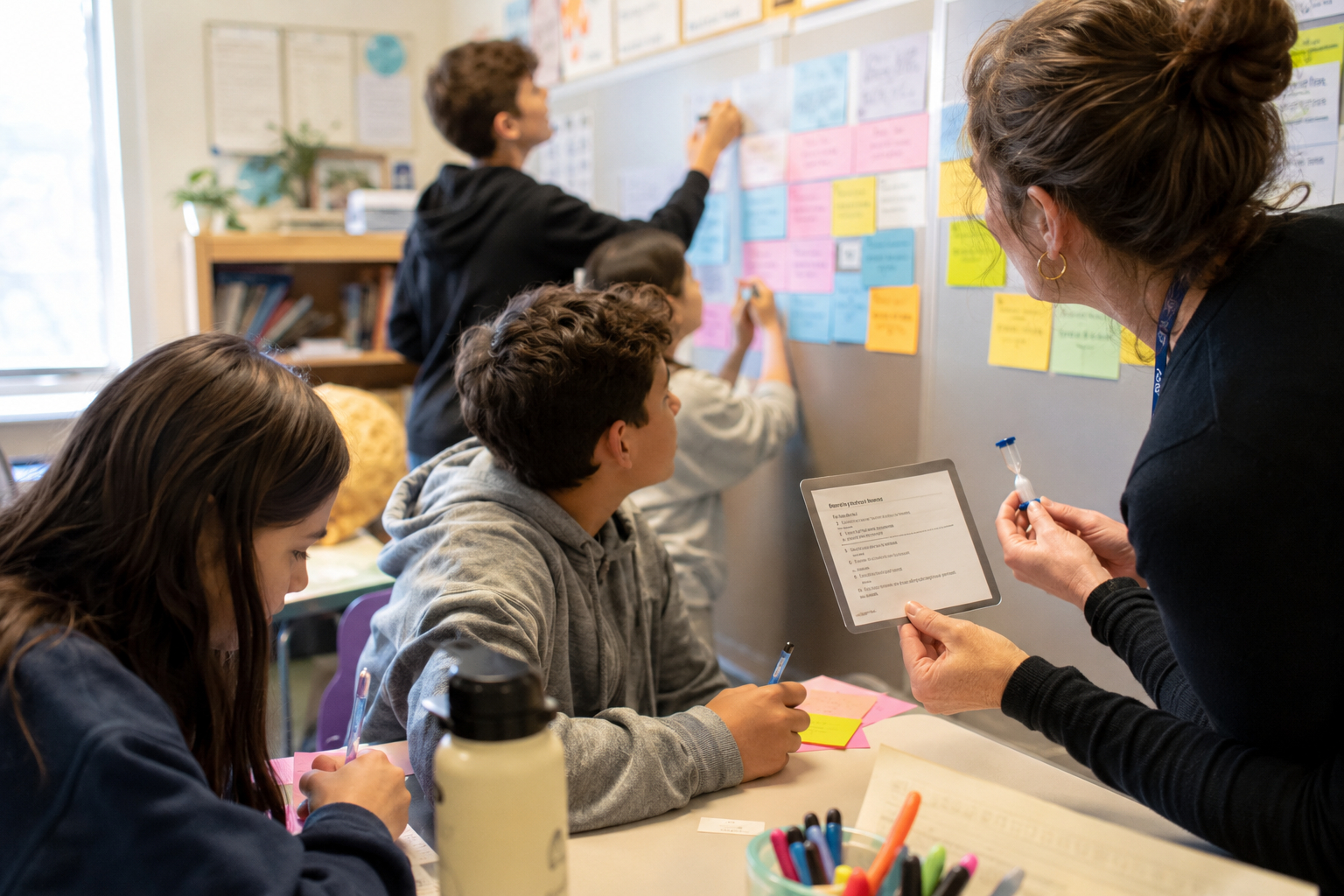
One-minute summaries are a compact routine teachers can introduce in minutes and reuse every lesson. They ask students to capture core ideas and application steps in a tightly timed format. Used regularly, the exercise builds precision, recall, and the habit of connecting learning to future work. This technique scales across ages and subjects while remaining low-cost and high-impact.
Why one-minute summaries work
When students must condense learning into a single minute they prioritize main ideas over peripheral details. The constraint encourages selection, synthesis, and a quick metacognitive check: do I understand this enough to explain it? Repeated practice strengthens retrieval pathways and reduces cognitive clutter, which helps transfer skills between contexts. Because summaries are short and frequent, they create low-stakes opportunities for revision and feedback.
Teachers gain rapid evidence of student understanding and common misconceptions. That information supports immediate adjustments without large testing overhead.
Teaching the one-minute summary routine
Introduce the task explicitly: model a one-minute summary, highlighting what to include and what to omit. Provide a simple frame—topic, two key points, one application—and practice it aloud with the class. Time the activity and make the rhythm predictable: teach, practice, one-minute summary, brief feedback. Start with whole-class examples, then move to pairs, individual quickwrites, or small group shares.
Consistent scaffolding and modeling help students internalize the frame and speed up over weeks. Keep expectations clear and celebrate concise, accurate summaries.
Adapting and assessing for different learners
Different students need tailored supports: sentence starters, visual templates, or additional thinking time. For multilingual learners, allow a bilingual summary or a sketch plus brief label to capture understanding. You can collect summaries digitally for quick scanning or use sticky notes to create a visual progress wall. Assessment can be formative: sample notes inform instruction rather than serve as high-stakes grading.
Use short rubrics focused on clarity and application to make feedback specific and actionable. Over time students can self-evaluate summaries against those criteria to build independence.
Sample prompts and quick templates
Offer simple prompts that guide attention and preservation of transferable elements. Examples include: “Summarize the idea in one sentence, list two ways to use it, and name one question.” Try a template: Topic — Key Point — Why it matters — One place to apply it. Rotate prompts to emphasize explanation, comparison, or application depending on lesson goals.
Short, repeated prompts help students form a mental checklist they can apply beyond your classroom. Templates also make classroom routines predictable and easier to assess quickly.
Conclusion
One-minute summaries make metacognition routine and portable for learners. They create frequent, low-stakes opportunities to practice transfer and clarity. With simple scaffolds, any teacher can introduce this habit and watch student independence grow.