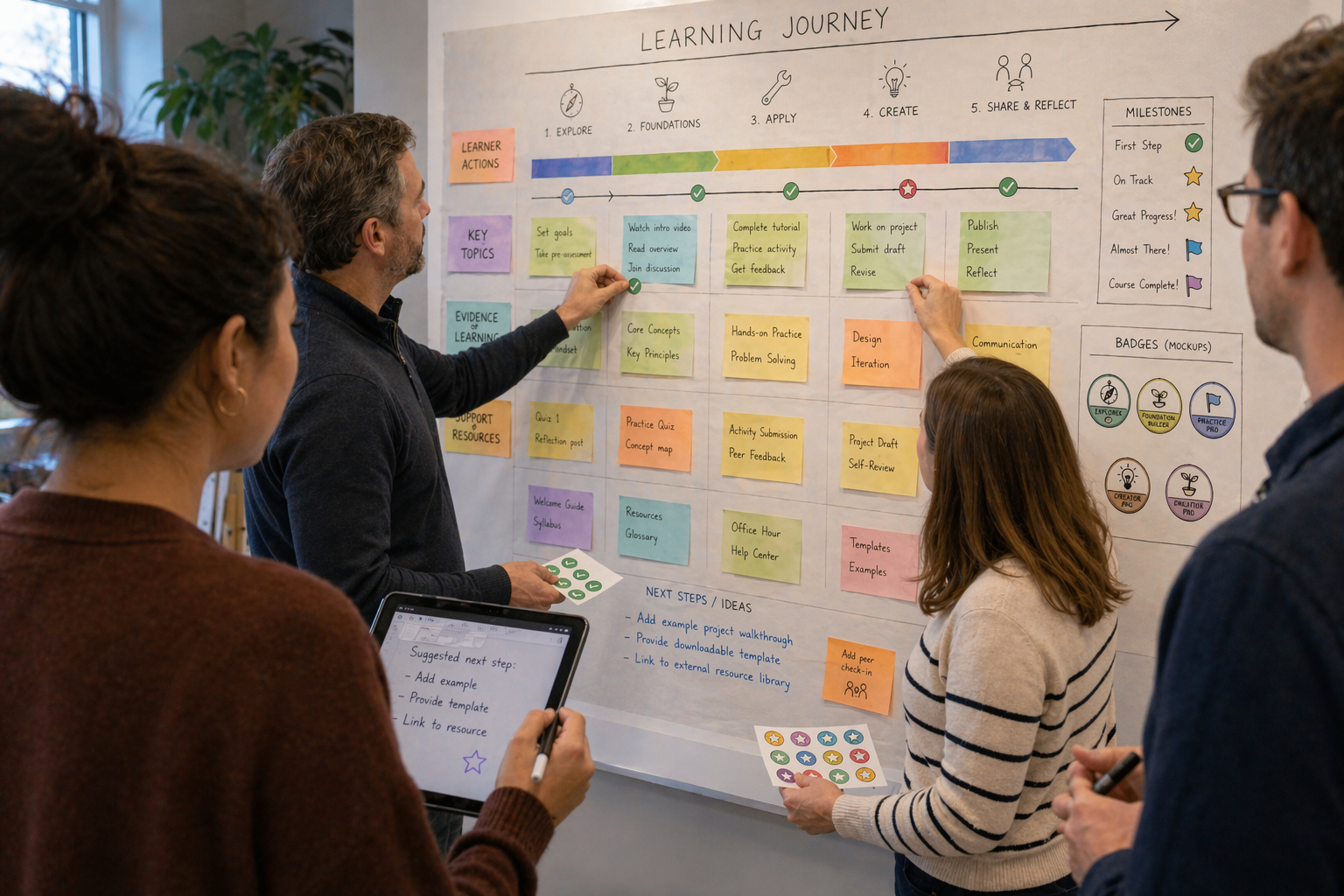
Transparent progress signals help learners understand where they are and what comes next. They reduce anxiety, boost motivation, and make remote learning feel more predictable. Designers can use checkpoints, badges, timelines, and micro-feedback to create clarity. This article outlines principles and practical examples to implement meaningful progress cues.
Why progress signals matter
Progress signals act as cognitive anchors that frame effort and achievement. When learners see immediate indicators of advancement, they are more likely to sustain engagement and return. Good signals balance granularity with salience so learners perceive small wins without being overwhelmed. They should connect directly to learning objectives and expected competencies.
Well-designed signals support self-regulated learning and feed into habit formation. They also provide instructors with diagnostic visibility.
Design principles for effective signals
Start with clear milestones that map to specific skills or outcomes. Use consistent visual language—progress bars, checkmarks, and color cues—to reduce interpretation time. Prioritize actionable feedback over generic praise so learners know what to repeat or revise. Ensure accessibility and mobile responsiveness so signals remain visible across devices.
Align signals with assessment so progress reflects meaningful mastery. Keep the number of cues manageable to avoid clutter.
Practical signal examples and patterns
Practical implementations vary by course length and audience but share common patterns. Short modules benefit from daily or weekly checkpoints while longer programs use stacked milestones and credentials. Micro-credentials and digital badges can mark competence in discrete areas and translate to external recognition. Simple triggers—like completion notifications or suggested next steps—help maintain momentum.
- Module completion badges tied to demonstrable tasks.
- Checkpoint reflections that record learner progress and time spent.
- Adaptive next-step suggestions based on quiz and activity performance.
Combine multiple signals to create a layered experience where learners receive both immediate and longitudinal feedback. Test which combinations produce sustained engagement for your audience.
Measuring impact and iterating
Measure the effectiveness of progress signals with engagement metrics, task completion rates, and qualitative learner feedback. Use A/B tests to compare variations of visual cues, messaging, and frequency. Track downstream outcomes like mastery retention and course completion to ensure signals correspond to learning, not just activity. Be prepared to simplify or intensify cues as data indicates.
Iteration should prioritize learner clarity and reduced friction. Small, frequent improvements often outperform large feature overhauls.
Conclusion
Transparent progress signals make learning journeys legible. They guide attention, motivate practice, and reveal mastery. Start small, measure impact, and refine over time.