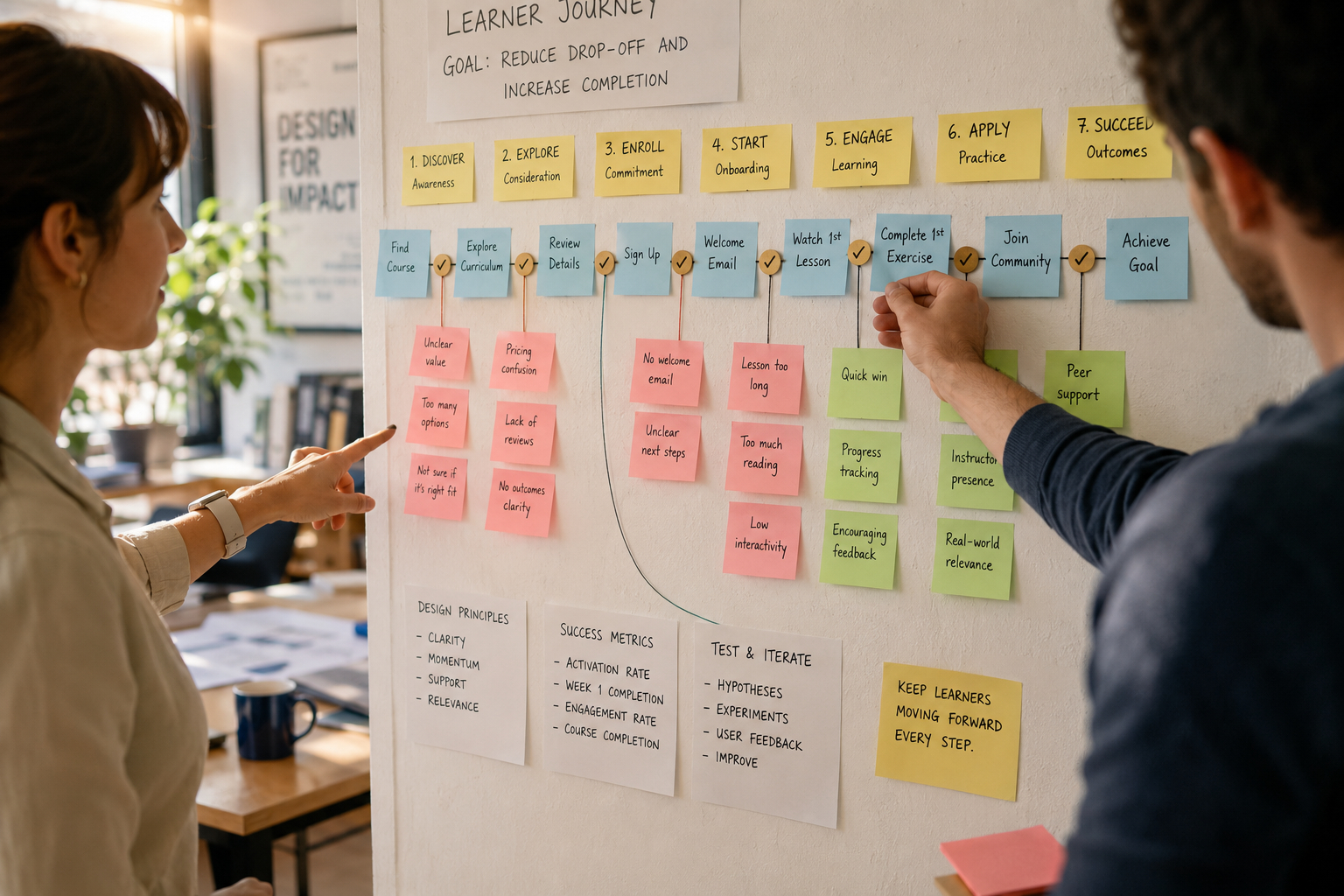
Reducing dropout in self-paced courses starts with crafting a learning flow that feels natural and achievable. When learners encounter fewer interruptions and clearer next steps, they are more likely to return and complete modules. Flow-friendly course design focuses on minimizing friction, offering timely signals, and aligning effort with reward.
This article outlines practical strategies to shape course paths that sustain momentum and reduce abandonment.
Why flow matters in course design
Flow creates a psychological sense of progress that keeps learners engaged and reduces the likelihood of churn. When sequencing, designers should limit cognitive load by grouping related tasks and providing consistent expectations. Clear entry points, predictable durations, and immediate relevance all contribute to smoother progress. These elements combine to make studying feel less like a series of obstacles and more like a guided experience.
Prioritizing flow also helps instructors identify where learners stall and why. Better flow translates into higher completion rates and stronger learning outcomes. Investing in this area yields measurable returns in learner satisfaction and retention.
Mapping friction points and smoothing paths
Start by auditing the learner journey to find moments of hesitation: unclear instructions, sudden jumps in difficulty, or technical barriers. Use analytics and learner feedback to locate dropoff pages, then simplify or scaffold those steps. Replace vague goals with concrete, time-bound tasks and offer examples to reduce uncertainty. Small interface improvements and clearer language often deliver outsized reductions in friction.
Fixes should be incremental and data-driven to avoid introducing new barriers. Treat the first module as a high-priority usability test since early experiences set expectations for the entire course.
Small checkpoints that preserve momentum
Checkpoint design is about signaling progress without creating busywork. Implement short, meaningful tasks that can be completed in a single sitting and tied to demonstrable learning. Provide immediate, constructive feedback that clarifies next steps and celebrates mastery. When learners see a visible trail of accomplishments, motivation compounds and the perceived distance to completion shrinks.
Design checkpoints to be optional pathways rather than hard gates when mastery can be iterated. This balance keeps momentum while preserving learner autonomy.
Measuring and iterating on flow
Track a mix of quantitative and qualitative signals: completion rates, time-on-task, heatmap dropoffs, and learner comments. Run small experiments—tweaking sequence order, adding micro-examples, or simplifying instructions—and compare cohorts. Prioritize changes that reduce early exit rates and improve first-week engagement. Continuous measurement allows teams to refine flow without large redesigns.
Iteration should be scheduled and scoped so improvements accumulate steadily. Small, consistent optimizations often outperform rare, sweeping overhauls.
Conclusion
Designing for flow reduces friction and supports sustained progress. Small, measurable changes often yield the biggest improvements in retention. Treat flow as an ongoing design priority rather than a one-time fix.