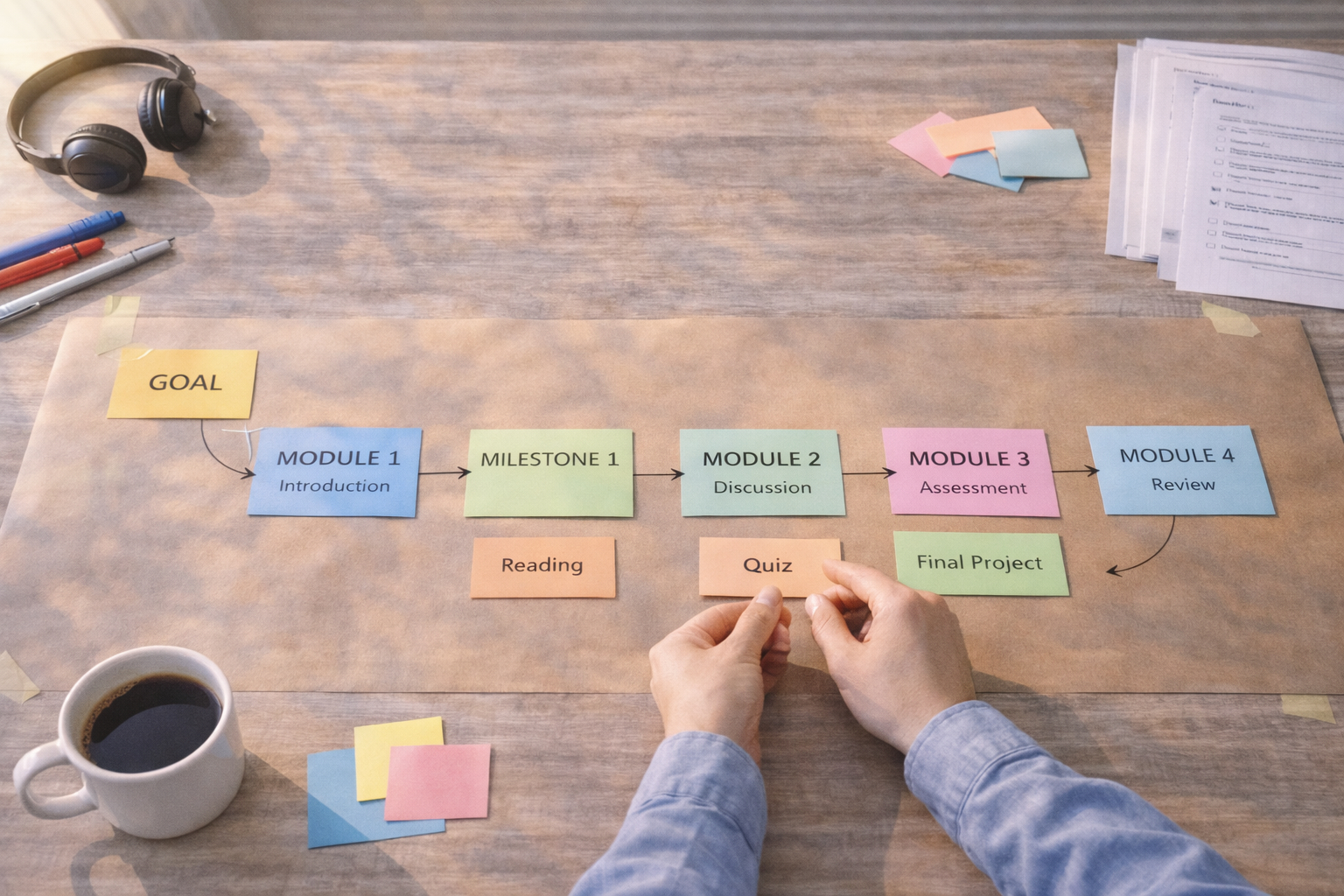
Online course success depends on how clearly content and activities are organized.
Learners move through material better when objectives, tasks, and assessments align.
This article outlines practical design choices to map course flow and support progress.
These approaches suit both self-paced and cohort-based online programs.
Instructors and designers can apply small adjustments with measurable effects.
Design for the Learner’s Journey
Start by defining the key milestones learners should reach and the competencies they will demonstrate. Map each module to a specific goal and sequence activities so that complexity increases gradually. Use explicit signposting so learners know why an item appears and what they should do next. Clear goals reduce confusion and increase completion rates. Build checkpoints that validate skill transfer to real tasks.
Include a short roadmap at the course start and module overviews to reinforce direction. Regularly revisit milestones so learners can gauge their own progress. Gather learner input on pacing and clarity to refine the roadmap.
Structure Content into Clear, Digestible Units
Break topics into short, focused units that address a single learning objective. Favor microlearning segments, two to fifteen minutes long, paired with a quick practice activity. Consistent formatting across units helps learners orient themselves and absorb material faster. Provide summaries and quick reference sheets to consolidate learning. Integrate short application tasks immediately after each micro-lesson.
Chunking content this way supports busy learners and improves retention. It also simplifies updates and content reuse. This format also supports analytics-driven personalization.
Encourage Interaction and Maintain Engagement
Design activities that require active use of knowledge, such as problem-solving tasks or peer critiques. Foster community through discussion prompts tied to assessment criteria and by enabling low-stakes collaboration. Blend synchronous touchpoints with asynchronous forums to accommodate different schedules. Track participation and intervene early when engagement drops. Celebrate small wins and highlight exemplary learner contributions.
Prompt feedback and visible community norms sustain motivation. Small, frequent interactions often beat occasional large events. Design prompts that lower the barrier to first contribution.
Use Assessment and Feedback to Guide Progress
Align formative checks with learning objectives so assessments signal readiness for next steps. Offer automated quizzes for immediate feedback alongside instructor comments on applied assignments. Design rubrics that clarify expectations and speed up consistent grading. Use analytics to spot patterns and adapt content where many learners struggle. Provide scaffolding that fades as learners demonstrate independence.
Feedback loops help learners correct course without losing momentum. Schedule reflection exercises to turn feedback into actionable plans. Use cohort-level insights to reorganize or clarify problematic modules.
Conclusion
Clear course flow reduces friction and supports measurable learner progress.
Small, purposeful design choices improve engagement, retention, and outcomes.
Adopt mapping, chunking, interaction, and feedback to make online learning work.