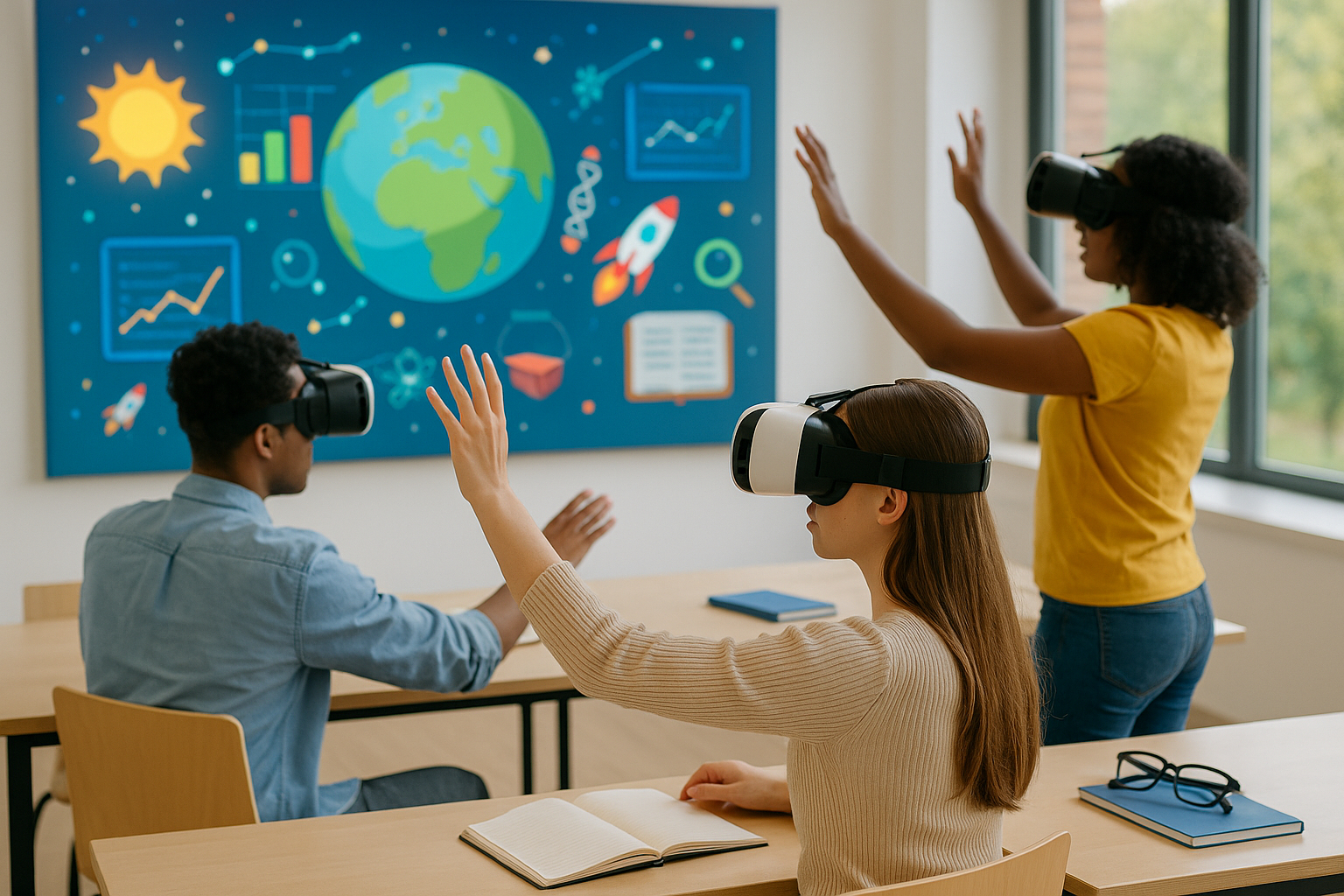
Virtual reality (VR) is transforming education by turning traditional lessons into immersive, hands-on experiences that spark curiosity and deepen understanding. Instead of just reading from textbooks or watching videos, students can now explore historical landmarks, walk through scientific simulations, and interact with 3D models — all from their classroom or home. As VR becomes more accessible, it’s reshaping how teachers engage students and how learners absorb information, making education more interactive, memorable, and personalized.
Bringing Lessons to Life Through Immersive Learning
VR allows students to step directly into the subject they’re studying, creating learning experiences that feel real and impactful. Whether exploring ancient civilizations, diving into ocean ecosystems, or zooming into the human bloodstream, VR captures attention in ways traditional methods cannot. This level of immersion enhances comprehension and helps students retain complex concepts more effectively.
Supporting Diverse Learning Styles
Every student learns differently, and VR provides a flexible solution that supports visual, auditory, and kinesthetic learners. Interactive simulations encourage hands-on exploration, making abstract or difficult topics easier to understand. Students who struggle with traditional lectures often find VR lessons more intuitive, helping bridge learning gaps and improving overall academic confidence.
Enhancing Collaboration and Engagement
VR isn’t just a solo tool — many platforms allow students to collaborate in shared virtual environments. This enables group problem-solving, virtual lab experiments, and interactive discussions in ways that feel natural and engaging. Teachers can guide virtual field trips or host collaborative challenges that encourage teamwork and communication, boosting both engagement and social interaction.
Making Education More Accessible
For schools with limited resources, VR offers access to experiences that would otherwise be impossible due to cost, distance, or safety concerns. Students can visit faraway landmarks, explore outer space, or practice complex scientific procedures without leaving the classroom. As VR becomes more affordable, it opens the door to equal learning opportunities across diverse educational settings.
Conclusion
Virtual reality is revolutionizing classroom experiences by making learning more immersive, interactive, and accessible. As more schools integrate VR into their curriculum, students gain deeper understanding, stronger engagement, and richer experiences that textbooks alone cannot provide. VR represents the next step in creating dynamic, future-ready classrooms that inspire curiosity and lifelong learning.